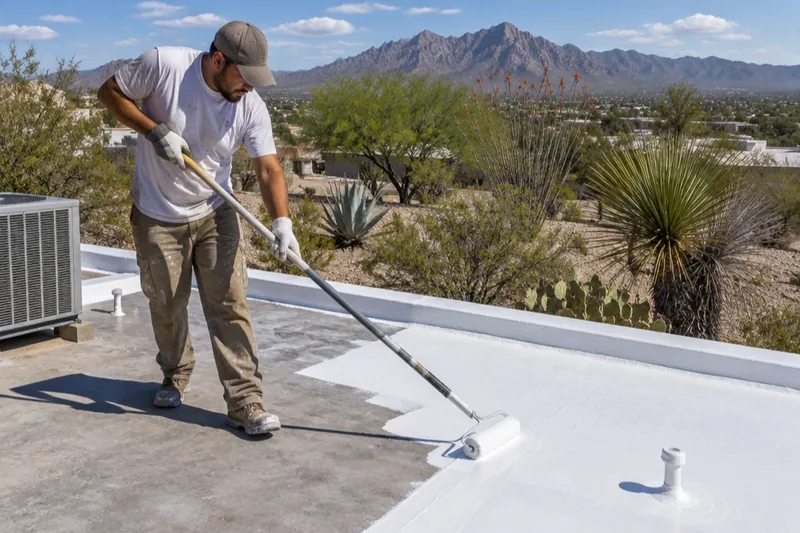
Why coatings matter more in El Paso
El Paso sees around 84 percent of its possible sunshine, and on a summer afternoon a dark roof can get far hotter than the air. Ultraviolet light is what wears out most low-slope roofs here: it dries out asphalt, cracks old coatings and chalks foam. A reflective white coating takes that hit instead, keeps the roof surface cooler and can cut heat into the rooms below. That's why so many El Paso flat roofs are white.
Types of roof coating compared
| Coating | Strengths | Weak points | Good fit |
|---|---|---|---|
| Acrylic elastomeric | Bright white, reflective, water-based, easy to recoat | Does not like standing water; needs warm, dry curing weather | Well-drained residential flat roofs, foam roofs |
| Silicone | Handles ponding water, stays flexible, strong UV resistance | Gets dirty faster; few materials stick to it later except more silicone | Roofs with drainage issues, metal and commercial roofs |
| Urethane | Very tough, resists foot traffic and impact | Stronger odour when applied; usually more expensive | Roofs with traffic, hail-prone areas, foam topcoats |
| Aluminium or asphalt-based | Low cost, compatible with old bitumen | Less reflective and shorter lived than elastomerics | Older built-up roofs on a tight budget |
Which one is right depends on your roof surface, how well it drains and what has been used on it before. A roofer should check compatibility before quoting.
How a roof coating is applied
- Inspection. The roofer checks for wet insulation, blisters and failed seams. Coating over wet roofing traps moisture.
- Repairs. Damaged areas are cut out and rebuilt, and parapet joints and penetrations are reinforced with fabric.
- Cleaning. The roof is power-washed to remove dust, chalking and loose coating. El Paso dust is the main reason coatings fail to bond.
- Primer, where needed. Some surfaces need a primer for the coating to stick.
- Base and top coats. The coating goes on in one or more coats at a set thickness, checked with a wet-film gauge.
- Curing. Most coatings need several dry hours before rain or dew. That is why coating is scheduled around the forecast, and why it is avoided during the monsoon or on cold nights.
What affects coating cost
- Roof area and the number of parapets, curbs and penetrations to detail
- Repairs needed before coating, especially wet areas
- Coating type and the thickness specified
- Whether old, peeling coating must be removed first
- Access and height
Coating a typical home's flat roof often takes one to three days including cleaning and curing time.
Signs your roof needs recoating
- White coating worn thin, with the grey or black base showing
- Chalky residue that comes off on your hand
- Cracking, crazing or peeling, especially near parapets
- Foam surface turning tan or brown and feeling soft or crumbly
Before the crew arrives
Coatings can drift in wind. Move vehicles away from the house, cover outdoor furniture and let neighbours know if you share a wall. Switch off the swamp cooler so it doesn't pull fumes or spray inside.
Is it ever an emergency?
Coating itself is planned work, not an emergency fix. If the roof is leaking now, start with leak repair and coat later in dry weather.