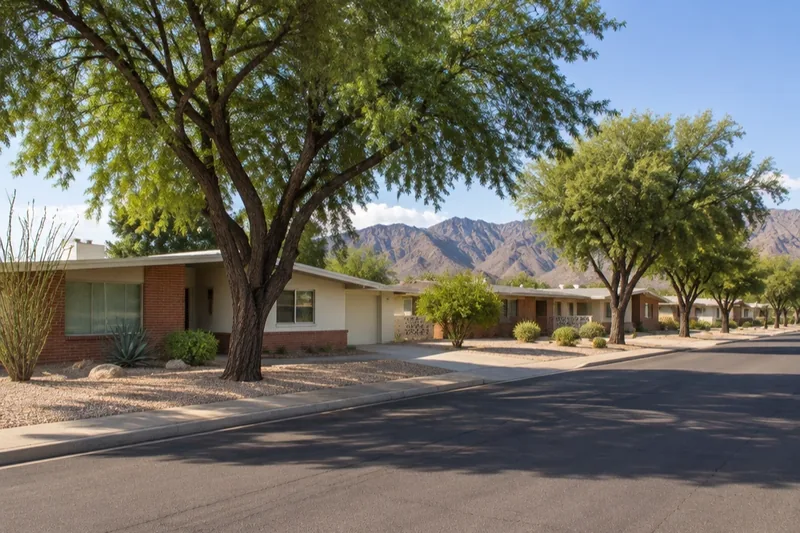
A part of town built for Fort Bliss families
Northeast El Paso grew up alongside Fort Bliss. Large parts of it were built in the 1950s and 1960s, east of the Franklin Mountains along Dyer Street and later US 54, the Patriot Freeway. Many of those homes are modest single-storey block or frame houses with flat or very low-slope roofs behind short parapets. Farther north, toward Hondo Pass, McCombs and the state line, newer subdivisions add pitched shingle and tile. ZIP codes 79904, 79924 and 79934 cover most of it.
What roofers check first on older Northeast homes
- The parapet joint. On roofs this age the original flashing at the wall is long gone. Whatever replaced it is often a coating that has cracked.
- Scuppers. Small original scuppers clog easily with blown sand from open lots.
- Layers. Some roofs have several generations of roofing on top of each other, which adds weight and hides wet insulation.
- Decking. Long-term leaks can rot the wood deck, which shows up as soft spots underfoot.
Wind and sand on the northeast edge
The northeast side sits open to the desert, and spring wind storms carry sand that scours coatings and piles up against parapets and in drains. Shingle roofs on newer streets near open land are more exposed to uplift. After a big wind event, check for granules in the gutters and pieces of shingle or flashing in the yard.
Repair, recoat or replace?
For a 1950s flat roof with dry insulation, a careful repair at the parapets plus a full recoat can buy many more years. If insulation is wet across large areas, or the roof has too many layers, replacing it with a single new system such as spray foam or modified bitumen is often the better investment. A roofer can core a small sample to check.
Military households
If you live off post and are moving on orders, tell the roofer your timeline. They can prioritise repairs that need to be done before a sale or rental.