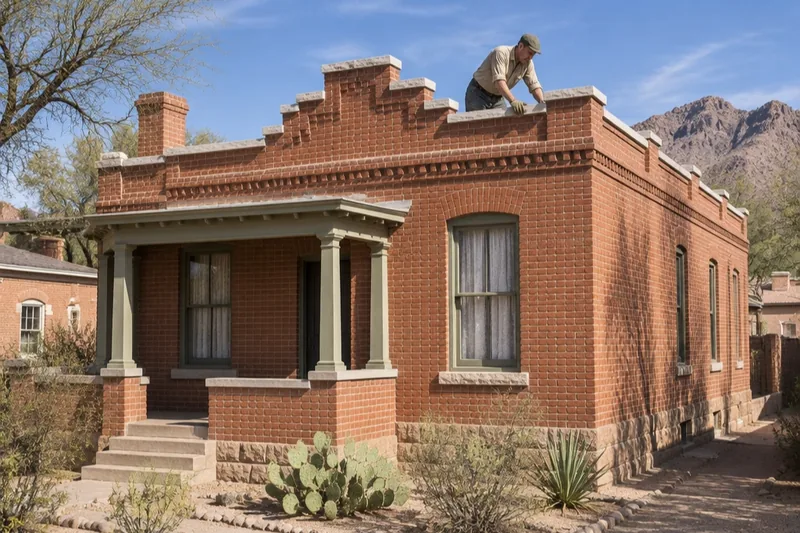
Older roofs need careful hands
Central El Paso has some of the city's oldest housing. Sunset Heights, just north of downtown, and Manhattan Heights, near Memorial Park, have many homes from roughly the 1900s to the 1930s: brick, stucco, Mission Revival and Pueblo Revival styles with flat roofs hidden behind stepped or curved parapets. Five Points and the streets along Montana Avenue add bungalows and small commercial buildings. ZIP codes 79901, 79902, 79903 and 79930 cover the core.
These buildings were not built with modern flashing details. The roof membrane often simply turns up the inside of a brick parapet, with mortar joints and a cap that have weathered for a century. Leaks frequently come through the masonry itself, not the roof surface.
Leak sources in historic Central homes
- Cracked parapet caps letting water into the wall cavity
- Eroded mortar joints on the inside face of parapets
- Old built-up roofing, often with many coats of asphalt and aluminium coating
- Undersized or corroded scuppers and downspouts
- Chimneys with failed flashing or crowns
- Additions where a newer roof meets the original wall
Repairs that respect the building
Ask the roofer how they will handle the masonry. Hard, modern mortars and some sealants can damage soft historic brick. On important facades, a mason may need to repoint parapets alongside the roof work. If your home is in a designated historic district, work visible from the street may need review by the city's historic preservation office before it starts, so check first.
Downtown and commercial roofs
Central El Paso also has older commercial buildings with large flat roofs, rooftop equipment and internal drains. Those need the same attention to drains and parapets on a bigger scale. See commercial roofing.
Monsoon on old roofs
Older roofs often have fewer, smaller scuppers than modern code would require. In a heavy monsoon storm they back up fast. Keeping them clear, and adding an overflow scupper where needed, prevents a lot of interior damage.