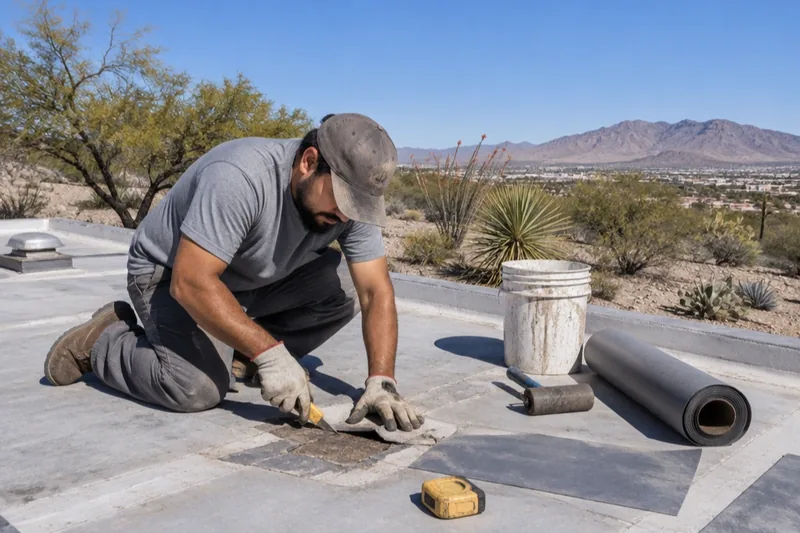
What a roof repair job involves
A repair fixes a defined problem on a roof that still has useful life left. On El Paso houses that usually means one of a handful of trouble spots. On flat roofs: the joint where the roof surface turns up the parapet wall, the parapet cap itself, scuppers and canales, and the curbs under swamp coolers and rooftop AC units. On pitched roofs: valleys, ridge caps, chimney and wall flashing, plumbing vent boots and the first rows of tile or shingle at the eaves.
The roofer's first job is to work out where the water actually gets in, which is rarely right above the stain on your ceiling. Water runs along decking and rafters before it drips. Expect them to walk the roof, look at the drains, press on soft areas and, if needed, check the attic or plenum space.
Signs your roof needs repair
- A brown ring or bubbling paint on a ceiling, especially after a monsoon storm
- Cracks in the stucco on top of or just below the parapet wall
- Bare grey or black patches showing through a white roof coating
- Water standing on a flat roof more than two days after rain
- Broken or slipped tiles, or shingles with missing tabs after a windy spring day
- Daylight or damp insulation in the attic
- Old tar patches that have shrunk and pulled away at the edges
How the repair is done
Good repairs follow the same order whatever the roof type. The roofer cleans and dries the area, cuts out or removes damaged material back to sound roofing, fixes any wet or rotten decking underneath, then rebuilds the layers in the right sequence so water sheds over each lap rather than into it. On a flat roof that may mean a reinforced fabric and coating patch, new modified bitumen, or a section of spray foam. On a tile roof it means lifting tiles, repairing underlayment and resetting or replacing the tile. Flashing is refastened or replaced and sealed with a product rated for roof temperatures, which can top 150°F in an El Paso summer.
What affects the cost and time
The roofer will price your repair after seeing it, but these are the things that move the number:
- Roof type and access. Clay tile and two-storey roofs take more time and care than a single-storey flat roof.
- Hidden damage. Wet decking or insulation found under the patch adds labour and materials.
- Size and number of problem areas. One vent boot is quick; a whole parapet run is not.
- Materials. Matching an older tile profile or a specific coating system can cost more.
- Timing. Night, weekend and storm calls may be priced differently. Ask when you call.
Most single repairs take a few hours to a day. Coatings need a dry, warm day and curing time before rain, so they may be scheduled around the forecast. For more detail, read what affects roof repair cost in El Paso.
Repair or replace?
| Situation | Repair usually fine | Replacement worth discussing |
|---|---|---|
| Leak location | One area, such as a vent, a scupper or a single valley | Leaks in several unrelated places |
| Decking | Solid, with no soft spots | Soft or sagging across large areas |
| Surface wear | Coating or shingles mostly intact | Coating cracked all over, shingles brittle and bald |
| Past patches | Few or none | Many layers of patches on top of each other |
The full decision guide is here: repair or replace your roof.
Before the roofer arrives
Move furniture and electronics away from any drip and put a bucket under it. If a ceiling is bulging with water, keep people out from under it. Take photos of the stain and of the roof from the ground; they help with any insurance claim. Clear a path to the side yard or ladder point, and tell the roofer about dogs, gates and locked access.
When is it an emergency?
Water coming through a light fixture, a sagging ceiling, a hole opened by wind or a fallen branch, or a leak that is getting worse in an active storm all need same-day attention. See emergency roof repair for what a roofer can do straight away.