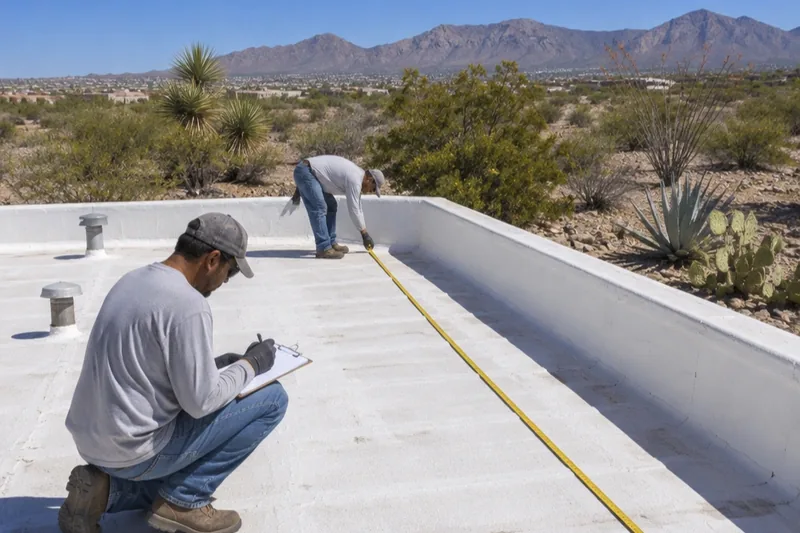
Nobody can give you an honest price for a roof repair without seeing the roof. What we can do is explain what roofers look at when they price a job, so you know what questions to ask and can tell a careful quote from a guess.
1. The type of roof
Different roofs take different skills, materials and time.
| Roof type | What makes repairs simpler | What makes repairs harder |
|---|---|---|
| Coated flat roof | Easy to walk, materials quick to apply | Finding the true leak source, wet insulation underneath |
| Spray foam | Small holes patch quickly | Weather windows for spraying, overspray protection |
| Modified bitumen or built-up | Well-understood patching methods | Multiple old layers, compatibility of new materials |
| Clay or concrete tile | Tiles themselves are durable | Tiles must be lifted to reach underlayment; breakage; matching |
| Asphalt shingle | Quick to replace individual shingles | Colour matching on faded roofs, brittle old shingles |
| Metal | Fasteners and seams are easy to reach | Rusted panels, custom trim |
2. Height, pitch and access
A single-storey flat roof with an easy ladder point is the simplest case. Two-storey homes, steep tile roofs in the Westside foothills, and properties with no side-yard access need more safety equipment, more time and sometimes more crew. Long carries from the truck to the ladder, locked gates, dogs and fragile landscaping all add time.
3. What's hiding under the leak
This is the biggest unknown in any repair. Water that has been getting in for a while soaks insulation, rots decking and sometimes framing. A small stain inside can sit above a large wet area on a flat roof. Good roofers will tell you up front how they handle this. Many give a price for the visible repair plus a per-unit price for any decking or insulation they find needs replacing, so there are no surprises.
4. The size and number of problem areas
One cracked vent boot is a short job. A parapet that has failed along an entire wall, or a tile valley that needs the underlayment replaced from top to bottom, is a full day or more. If a roofer finds several unrelated problems, ask them to price each one separately so you can prioritise.
5. Materials and compatibility
Using the right material matters more than using the cheapest. On El Paso flat roofs, coatings must suit the surface they go on and the drainage, so silicone is used where water ponds and acrylic where it doesn't. Matching an older tile profile might mean sourcing salvaged tile. Better flashing metal and higher-grade underlayment cost more but last longer in this heat.
6. Timing and weather
Emergency and after-hours calls during storms may be priced differently from scheduled work. Ask when you call. Demand also spikes after big hail or wind events, when schedules fill quickly. On the other hand, coatings and foam can only go on in dry, mild weather, so some work is scheduled around the forecast rather than rushed.
7. Permits
Small repairs usually don't need a permit, but re-roofing in the City of El Paso does, and the permit fee becomes part of the job. See do you need a permit to re-roof in El Paso?
How to compare roofing quotes
- Get it in writing. A clear scope listing what will be removed, repaired and installed, and with what materials.
- Check the hidden-damage terms. How will rotten decking or wet insulation be priced if found?
- Compare the same scope. A cheap quote that only seals over a problem is not comparable to one that replaces flashing.
- Ask about workmanship terms. Each independent roofer sets their own. Get them in writing.
- Check insurance. Ask for a certificate of insurance. In New Mexico, check the roofer's CID licence too.
- Be careful with large upfront deposits, especially from door-to-door crews after storms.
Repair now or wait?
Small roof problems in El Paso rarely stay small through a monsoon season. A vent boot or parapet crack that costs little to fix in May can soak a ceiling and insulation by August. If you are deciding between repairing and replacing, read repair or replace: an El Paso decision guide.
Ways to keep repair costs down
- Clear scuppers, canales and gutters before monsoon season
- Have the roof inspected every year or two, especially flat and foam roofs
- Recoat flat roofs before the coating wears through, not after
- Keep foot traffic off tile roofs
- Fix small leaks right away
Questions to ask on the phone
Before anyone comes out, it is fair to ask whether there is a charge for the inspection, whether they price emergency and after-hours work differently, and how soon they can provide a written quote.