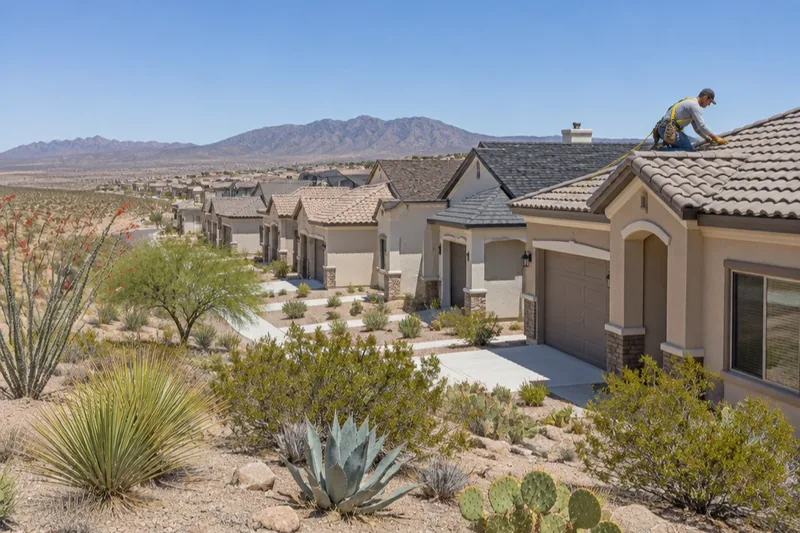
A young city with young roofs
Horizon City grew by about a third between 2010 and 2020, reaching 22,489 people, and new streets keep appearing along Horizon Boulevard and Eastlake Boulevard. Most homes in ZIP code 79928 are single- and two-storey stucco with pitched roofs: flat or S-tile concrete on many, laminated shingles on others. Few homes here are old enough to need full replacement for age alone. Most calls are for damage.
Wind at the edge of the desert
Horizon City sits on open mesa east of El Paso, and many subdivisions back directly onto undeveloped desert. Spring wind storms, often from March to May, hit these edges with nothing to slow them. Roofers in Horizon City see a lot of:
- Shingles torn or lifted along rakes and ridges on the windward side
- Ridge and hip tiles knocked loose
- Sand piled in valleys and gutters, wearing granules off shingles
- Loose drip edge and flashing at roof corners
Common repairs on newer homes
- Vent boots. The rubber collars around plumbing vents crack in the sun after roughly ten to fifteen years.
- Cracked tiles. Foot traffic from cable, solar or holiday-light installs breaks concrete tile.
- Roof-to-wall flashing on two-storey homes, where a lower roof meets an upper wall.
- Hail. Monsoon storms bruise shingles and chip tile.
Builder warranties and insurance
If your home is only a few years old, check whether any builder warranty still covers the roof before you pay for a repair. For storm damage, document it with dated photos and contact your insurer. Our insurance guide explains what is usually covered.
Before you call from Horizon City
Tell the roofer the roof type (tile or shingle), whether the home is one or two storeys, and whether there are solar panels or an HOA. If the damage followed a specific wind storm or hail event, give the date. It helps with any insurance claim and tells the roofer what to look for first.
Horizon City is served by both the Clint and Socorro school districts, and new homes keep going up on its eastern edge.