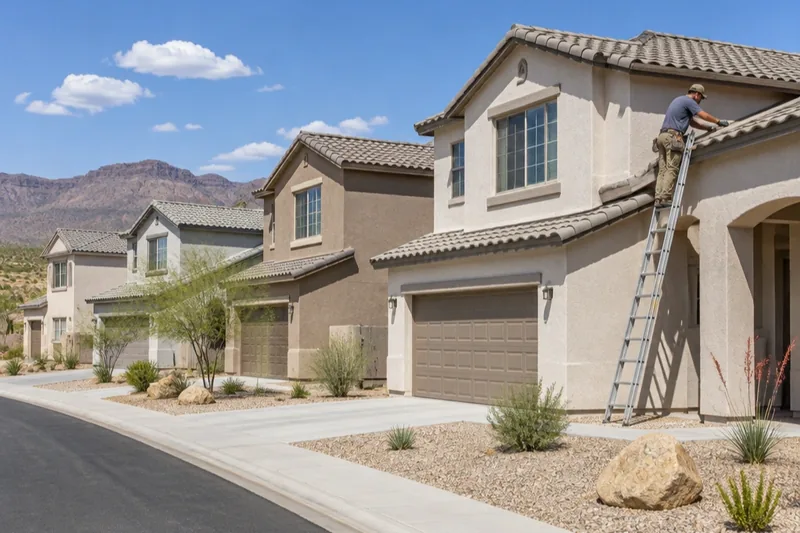
Newer homes, different problems
East of Loop 375 (Joe Battle Boulevard), El Paso has grown fast. Subdivisions around Montwood, Pebble Hills, Tierra del Este and the Eastlake corridor are mostly two-storey stucco homes with pitched roofs: flat or S-profile concrete tile on many, architectural shingles on others. ZIP codes 79938 and 79936 cover much of this side of town.
Being newer does not mean trouble-free. Roofers see a pattern on homes of this age:
- Cracked concrete tiles from foot traffic by solar, satellite and holiday-light installers
- Vent boots and pipe flashing drying out and cracking in the sun after ten to fifteen years
- Wind damage on open edges. Homes backing onto open desert take the full force of spring winds
- Hail damage to shingles and soft metals during monsoon storms
- Builder-grade flashing at roof-to-wall joints on two-storey homes, where the upper wall meets the lower roof
Two-storey roof-to-wall leaks
One of the most common Far East leaks shows up on the first-floor ceiling right below where a lower roof meets the second-storey wall. Water gets behind the stucco or past the step and kick-out flashing, then runs down into the ceiling. The fix often involves both roofing and stucco work. A roofer can tell you whether flashing alone will solve it.
Solar panels and your roof
Many Far East homes have rooftop solar. If a leak appears near panel mounts, tell the roofer up front. They may need to coordinate with the solar company, and some panel warranties require specific procedures before mounts are disturbed.
HOAs and roof work
Some Far East subdivisions have homeowners associations with rules on tile colour and materials. Check before a large repair or replacement so the roofer can order the right product.
Monsoon runoff on new streets
Many Far East subdivisions were graded on open desert, and some streets sit below undeveloped slopes. Heavy monsoon rain carries sand onto roofs and into gutters, where it wears shingle granules and blocks downspouts. Check gutters after big storms.