Why roofs leak in El Paso
Most leaks here come from a short list of causes, and knowing them helps you describe the problem when you call.
- Parapet joints. On flat roofs the membrane or coating turns up the inside of the parapet wall. Sun and movement crack it there first, and water pooling against the wall pushes straight in.
- Scuppers and canales. Blown dirt, tumbleweed pieces and leaves block the drains. Water backs up and finds the weakest seam.
- Cooler and AC curbs. Swamp coolers drip constantly in summer. If the curb flashing or the drain line fails, water runs under the roof.
- Penetrations. Plumbing vents, flues and conduit lose their sealant as it bakes.
- Cracked parapet caps and stucco. Water gets into the wall itself and shows up inside, well below the roof.
- Tile underlayment. On tile roofs the tiles shed most water; the felt or synthetic layer beneath does the real waterproofing. When it ages out, leaks start even with no tiles broken.
How a roofer finds the leak
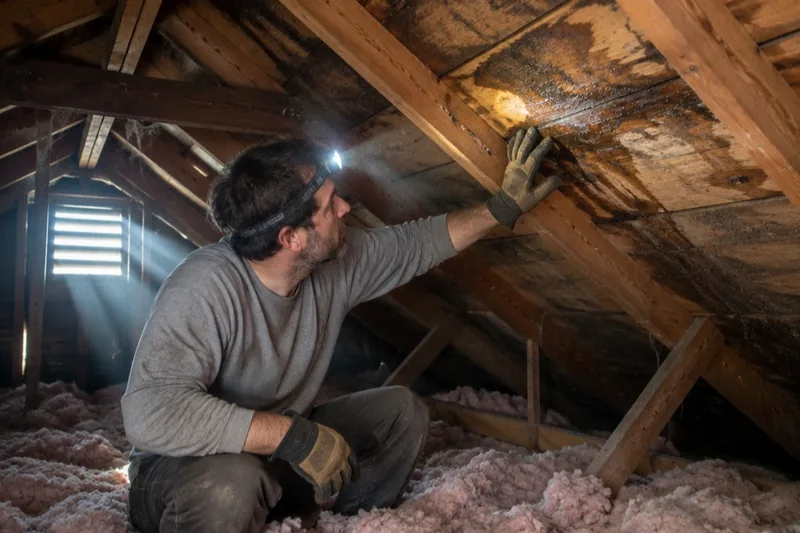
Expect a methodical check, not guesswork. The roofer looks at where the stain is inside, then works uphill from it on the roof, checking every seam, penetration and flashing in that path. They look for crazed coating, open laps, nail pops and rust. On flat roofs they look for water lines on the parapet that show how high water has pooled. If it is not obvious, some roofers use a moisture meter, an infrared camera or a careful water test, running a hose on one section at a time while someone watches inside.
How the leak is fixed
Once the source is confirmed, the fix matches the roof. On coated flat roofs it is usually cleaning, priming and a fabric-reinforced coating patch that laps well past the damage. On modified bitumen it is a heat-welded or cold-applied patch. On foam roofs the damaged foam is cut out, refilled and recoated. On tile roofs the tiles come up so the underlayment and flashing can be repaired properly. Wet insulation and decking found along the way should be replaced. Left in place, it keeps the leak smelling and sagging.
What affects the cost and how long it takes
Price depends on how hard the leak is to find, how much material needs to come off to fix it, and whether there is damage underneath. A single flashing or vent repair is quick. A leak that needs tiles lifted across a valley, or a parapet that needs re-wrapping along a whole wall, takes longer. If you are wondering about insurance, our guide to homeowners insurance and roof leaks in Texas explains what is usually covered and what isn't.
What to do before the roofer arrives
- Catch the water with buckets or towels and move belongings out of the way.
- If the ceiling is bulging, keep everyone out from under it. Some people poke a small hole to drain a bulge into a bucket; only do this if you can reach safely and the area is clear of wiring.
- Turn off the swamp cooler if the leak is near it.
- Photograph the inside damage with the date showing.
- Do not go on the roof in the rain or wind. Wet coatings and tile are very slippery.
When a leak is an emergency
A leak near electrical fixtures, water through more than one ceiling, a sagging ceiling or a leak getting worse during a storm should be treated as urgent. Ask for emergency roof repair and a roofer can tarp or temporarily seal the roof until a permanent repair is possible.