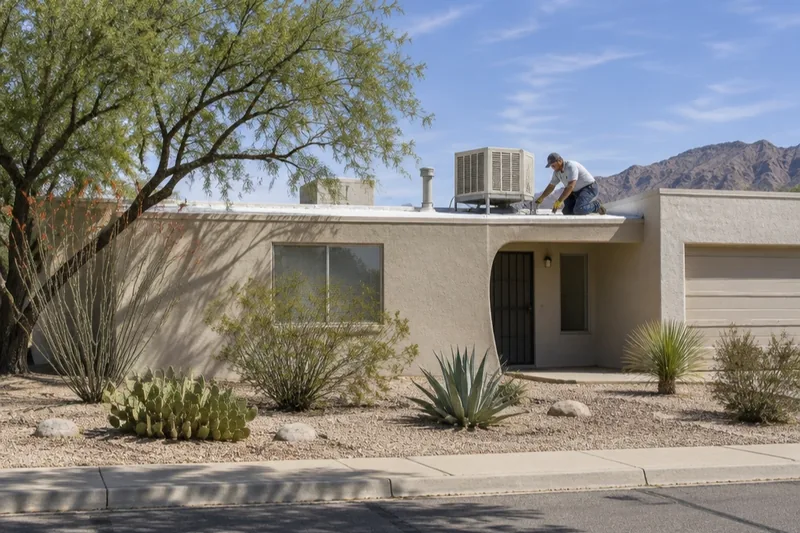
Why roof leaks often start around the cooler
Drive the streets between Airway Boulevard, Yarbrough and Lee Trevino and you will see swamp coolers on rooftop stands everywhere. They work well in El Paso's dry heat, but they put water on the roof all summer. When the cooler pan overflows, a drain line cracks, or the flashing around the stand or duct curb fails, water runs under the coating and appears inside, often far from the cooler. A large share of summer leaks in East El Paso trace back to the cooler. A roofer checks that before anything else.
What East El Paso homes are built like
Much of East El Paso was built from the 1960s into the 1990s as the city spread toward the airport and beyond. You will find single-storey block and frame homes with stucco, many with flat roofs behind low parapets, and plenty of low-slope and pitched shingle roofs on later streets. ZIP codes 79925, 79935 and 79936 cover a lot of it. These roofs are now old enough that many have been coated, patched and recoated several times.
Common problems on the Eastside
| Issue | Where it shows up |
|---|---|
| Layered old patches | Flat roofs repatched over decades, now cracking at every layer |
| Worn coating | Grey or black base showing through white elastomeric |
| Cooler curb leaks | Summer leaks near hallways and bedrooms under the cooler |
| Brittle shingles | South and west slopes of older pitched roofs |
| Hail bruising | Shingle roofs after monsoon storms |
When a flat roof has many layers of patches, a roofer may suggest a full recoat or, if insulation is wet, a new system such as spray foam. That ends the cycle of patching.
Monsoon season on the Eastside
Flat neighbourhoods drain slowly in a cloudburst. Make sure scuppers are clear before July, and that water from them is directed away from the foundation. If a storm leaves water standing on the roof for more than a couple of days, mention it when you call.