Commercial roof systems in El Paso
Most commercial roofs here are low-slope, from strip centres along Montana and Zaragoza to warehouses near the airport and the industrial parks on the east side and in Santa Teresa. They carry heavy rooftop equipment, take a lot of sun and must drain large areas fast in a monsoon cloudburst.
| System | How it works | Watch points |
|---|---|---|
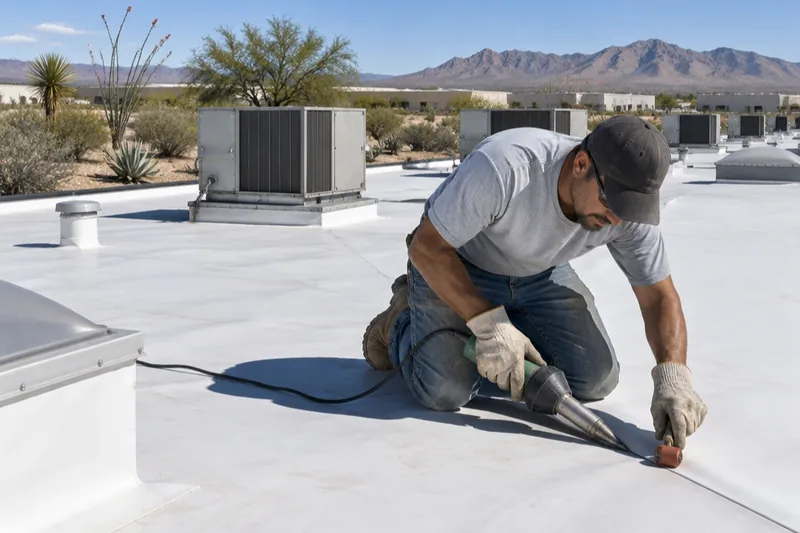
| TPO | White single-ply membrane, heat-welded seams | Seam welds, flashing at curbs and walls, punctures from foot traffic |
| PVC | Single-ply membrane, heat-welded, chemical resistant | Good near restaurant exhaust; check seams and flashing |
| Spray polyurethane foam | Sprayed in place, seamless, insulating, coated | Keep the coating intact; patch punctures promptly |
| Modified bitumen | Rolled asphalt membrane, torched or adhered | Seams, blistering, UV wear on the cap sheet |
| Built-up (BUR) | Layers of felt and asphalt, gravel or coated | Splits, blisters, gravel displaced from high-traffic areas |
| Restoration coating | Silicone or acrylic over a sound existing roof | Requires dry substrate; renew on schedule |
Common commercial roof problems
- Leaks at HVAC curbs, exhaust fans and pipe penetrations
- Blocked roof drains and scuppers causing ponding and overflow
- Seam failures on single-ply membranes
- Punctures from technicians walking the roof
- Grease from kitchen exhaust degrading the membrane
- Wet insulation spreading under the membrane from a small leak
How commercial roof repair and replacement work
A roofer starts with an inspection: walking the roof, checking drains, seams, flashing and curbs, and often taking moisture readings or infrared images to map wet insulation. Repairs use the same system as the roof: hot-air welding for TPO and PVC, foam and coating for SPF, and compatible patches for bitumen. If much of the insulation is wet, replacing those sections or the whole roof is usually more cost-effective than chasing leaks. Restoration coatings can extend the life of a dry, sound roof without a tear-off.
Keeping the business running
Ask the roofer how they will handle access, noise, odours from adhesives or foam, and protection of rooftop equipment. Many commercial jobs are phased so parts of the building stay open, and some work happens early in the day to avoid peak heat.
What affects cost and time
- Roof area and the system chosen
- Amount of wet insulation to remove
- Number of curbs, drains and penetrations
- Access, height and staging for materials
- Working-hour limits and phasing
- Permits for re-roofing
Maintenance plans
Commercial roofs last longest with regular inspections, ideally before and after monsoon season, plus drain clearing and prompt repairs. Ask about a roof inspection schedule.
When it is an emergency
Water through ceiling tiles onto stock, equipment or customers calls for same-day help. Ask for emergency roof repair.
Protecting the roof from other trades
On many commercial roofs, the biggest source of new damage is people working on the equipment: dropped screws, dragged panels and boots on soft membrane. Walk pads to and around HVAC units, a simple sign-in log for rooftop access, and a quick roof check after equipment work all cut down on punctures. Ask the roofer to include walk pads in any new roof or restoration.