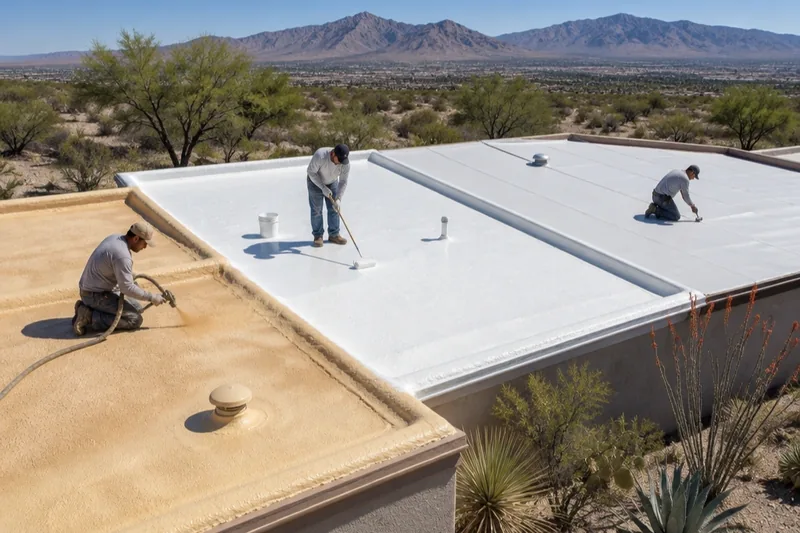
Most flat roofs in El Paso end up with one of three solutions when the old roof wears out: spray polyurethane foam with a protective coating, a coating system over the existing roof, or a single-ply membrane such as TPO. All three can work well here. They solve different problems.
How each system works
Spray foam (SPF). Liquid foam is sprayed onto the roof and expands into a seamless layer, typically an inch or more thick, that bonds to the deck and parapet walls. It insulates and can be built thicker in places to create slope toward drains. It must be covered with an elastomeric, silicone or urethane coating to protect it from UV.
Coating system. A liquid coating, usually acrylic elastomeric or silicone, is applied over an existing roof that is dry and sound, after repairs and reinforcement at seams and parapets. It renews the waterproof surface and reflects sun, but doesn't add insulation or change slope.
TPO membrane. Thermoplastic polyolefin comes in wide white rolls that are mechanically fastened or adhered over insulation board, with seams welded by hot air. It is common on commercial buildings and on larger residential flat roofs.
Side-by-side comparison
| Factor | Spray foam + coating | Coating over existing roof | TPO membrane |
|---|---|---|---|
| Seams | None | Depends on existing roof; seams reinforced | Heat-welded seams |
| Insulation | Adds insulation | None added | Over new insulation board |
| Fixes ponding | Yes, foam can be tapered | No; silicone tolerates ponding | With tapered insulation |
| Parapets and odd shapes | Excellent, sprays into corners | Good, with fabric reinforcement | Needs careful detailing |
| Sun and UV | Protected by coating; foam exposed if coating wears | Reflective; renew on schedule | White and reflective |
| Hail and foot traffic | Punctures need prompt sealing; granules help | Depends on coating type and thickness | Can puncture; patches weld on |
| Main upkeep | Recoat before foam is exposed | Recoat periodically | Inspect and repair seams and flashing |
| Disruption | Overspray risk, needs calm days | Least disruptive | Noise and deliveries, no overspray |
| Best fit | Homes with parapets, ponding, poor insulation | Sound, dry roofs needing renewal | Commercial and large residential roofs |
Which one suits your roof?
Choose a coating if
- The existing roof is dry and well attached (a roofer should check)
- Drainage is reasonable, or you will use silicone where water ponds
- You want the lowest disruption and cost now
Choose spray foam if
- Water ponds and you want to build in slope
- You want more insulation under the roof
- The roof has many parapets, curbs and odd shapes
- You are comfortable keeping up with recoats
Choose TPO if
- The roof is large or commercial, with a lot of open field area
- You want a factory-made membrane with welded seams
- The building can't tolerate overspray risk
What all three need
Whatever system you choose, the details decide whether it lasts in El Paso: the joint at the parapet, the scuppers and canales, the curbs under swamp coolers and AC units, and the penetrations. Ask any roofer how they will handle those, and what maintenance they recommend before and after monsoon season.
Questions to ask before you decide
- Is my existing roof dry? How did you check?
- How thick will the foam or coating be, and how will you verify it?
- How will you deal with ponding areas?
- What happens at the parapets and scuppers?
- What maintenance and recoat schedule do you recommend?
- What are the manufacturer warranty and your workmanship terms?
More detail: foam roofing, roof coating and commercial roofing.
How each handles El Paso's weather
Sun and heat
All three can be white and reflective. With foam and coatings, reflectivity depends on keeping the surface clean and the coating intact, because El Paso dust dulls white surfaces over time. TPO is white from the factory and is often cleaned during maintenance.
Monsoon downpours
Drainage matters more than the material. Foam has an advantage because it can be sprayed thicker in low spots to create slope. With a coating, ponding areas call for silicone or for fixing the slope first. TPO is installed over insulation that can be tapered toward drains.
Hail
Hail can puncture any of these systems. Foam and coating punctures are sealed with more coating, or foam and coating. TPO punctures are patched by heat-welding a new piece of membrane over them. What matters most is finding and fixing damage soon after a storm.
Wind
Foam is fully adhered, so it resists wind uplift well. Coatings depend on the roof beneath them. TPO must be fastened or adhered to the manufacturer's specification, especially at edges and corners.
What about modified bitumen?
Modified bitumen is another common choice for El Paso homes, especially on older built-up roofs. It is a proven, tough membrane, often finished with granules or a reflective coating. If a roofer recommends it, ask the same questions about drainage, parapet details and maintenance.