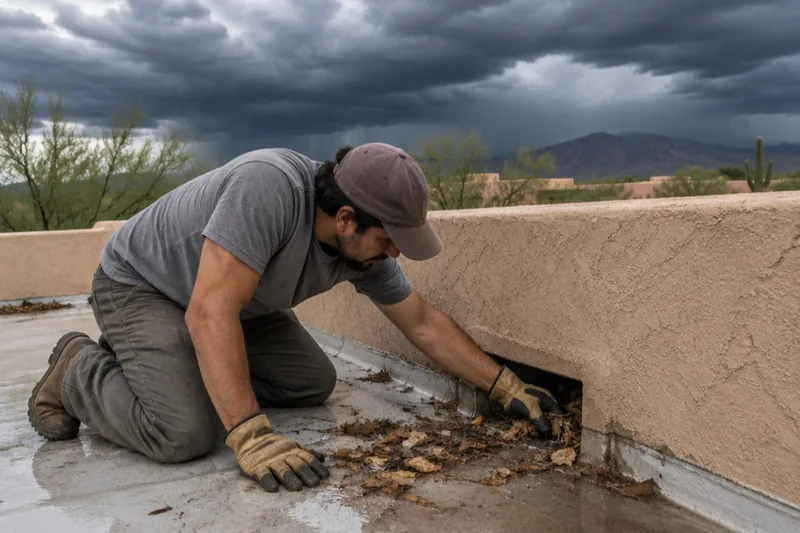
Why the monsoon is hard on El Paso roofs
El Paso averages under nine inches of rain a year, and the National Weather Service counts the monsoon season as 15 June to 30 September. During that window the region receives a large share of its annual rainfall, often in fast, localised thunderstorms that can also bring hail and strong outflow winds. A roof that has been dry for months suddenly has to move a lot of water in a short time.
Most monsoon leaks are not caused by the roof surface wearing out overnight. They happen because water can't get off the roof fast enough and pools against parapets, or because small cracks that were harmless in dry months finally get tested.
The checklist
You can do the ground-level checks yourself. Leave anything on the roof to a roofer.
From the ground
- Look at the stucco below each scupper and canale. Dark streaks or eroded stucco mean water is overflowing or leaking at the outlet.
- Check that water will land away from the house. Downspouts and canales should discharge away from walls and foundations.
- Look up at parapet caps. Visible cracks or missing pieces of stucco let water into the wall.
- Look for debris. Tumbleweed, leaves or plastic bags visible on the roof edge are a warning.
- Check ceilings under the roof edges and around the cooler for old stains.
- Trim trees back from the roof so wind can't drag branches across it.
On the roof (for a roofer)
- Clear every scupper, canale, drain and gutter, and check the seal around each opening
- Inspect the joint where the roof meets the parapet wall
- Check coating thickness and look for worn-through areas or crazing
- Reseal around plumbing vents, flues and conduit
- Check swamp cooler and AC curbs, pans and drain lines
- Look for soft spots or blisters that may hold water
- On tile roofs, clear valleys and check for cracked or slipped tiles
- On shingle roofs, check for lifted tabs from spring winds
Swamp coolers and monsoon humidity
Evaporative coolers lose some cooling power when monsoon humidity rises, and many households run them harder. That means more water on the roof. Make sure the pan isn't overflowing, the drain line is intact and routed to a drain or off the roof, and the curb flashing is sound. A surprising number of "monsoon leaks" are really cooler leaks.
Coating before the storms
If your flat roof needs a recoat, aim to have it done in spring, well before the monsoon. Most coatings need several dry hours to cure. Afternoon storms in July and August can wash fresh coating off or stop it bonding. See roof coating.
When a storm hits
- If water comes in, move belongings and catch it with buckets and towels.
- Keep away from ceiling fixtures that are wet, and turn off the circuit at the breaker if needed.
- Don't go on the roof during the storm or while it is wet.
- Photograph damage inside and out, with the date.
- Call a roofer and say clearly whether water is coming in now. See emergency roof repair.
After the storm
Once things dry out, walk around the house and look for shingle or tile pieces, dented gutters and cooler housings, and new streaks on the stucco. Any hail big enough to dent soft metal is worth a roofer's inspection. See hail and wind damage repair.
A simple yearly schedule
| When | What to do |
|---|---|
| Late autumn | Clear leaves from valleys and drains after leaf drop |
| Spring (March to May) | Check for wind damage; schedule coatings and repairs |
| May to early June | Pre-monsoon inspection and drain clearing |
| July to September | Check after big storms; clear drains of storm debris |
| October | Post-monsoon look for any new damage |
Roof-specific tips
Flat and coated roofs
The joint where the roof meets the parapet wall is the most common monsoon leak point in El Paso. Ask the roofer to look closely at the coating along every wall, and to reinforce it with fabric where it has cracked. Make sure every scupper has a smooth, sealed path out through the wall, with nothing like a lip of old patching that holds water back.
Foam roofs
Look for bare tan or brown foam where the coating has worn, and small holes from birds or hail. Those spots should be sealed before the storms, because exposed foam absorbs water and erodes faster.
Tile roofs
Valleys are the weak point. Leaves, dust and broken tile pieces build up there and dam water in a heavy storm, pushing it under the tiles and onto the underlayment. Have valleys cleared and broken tiles replaced.
Shingle roofs
Spring winds leave lifted or creased tabs that don't always show from the ground. A quick roof walk before the monsoon finds them while they can still be resealed rather than replaced.
If you rent
Tenants are usually not responsible for the roof, but you can help by telling your landlord early about stains, cooler leaks or blocked canales before the season starts.